Policy Day: Spectrum, Auctions and the Rules of the Network
Published September 20, 2026
The original conference closed with a Policy Day, and the choice made sense. Few industries are so thoroughly shaped by government decisions. Who may use which frequencies, who has to carry whose traffic, and who pays for rural service are all political questions that end up as engineering constraints.
Spectrum auctions
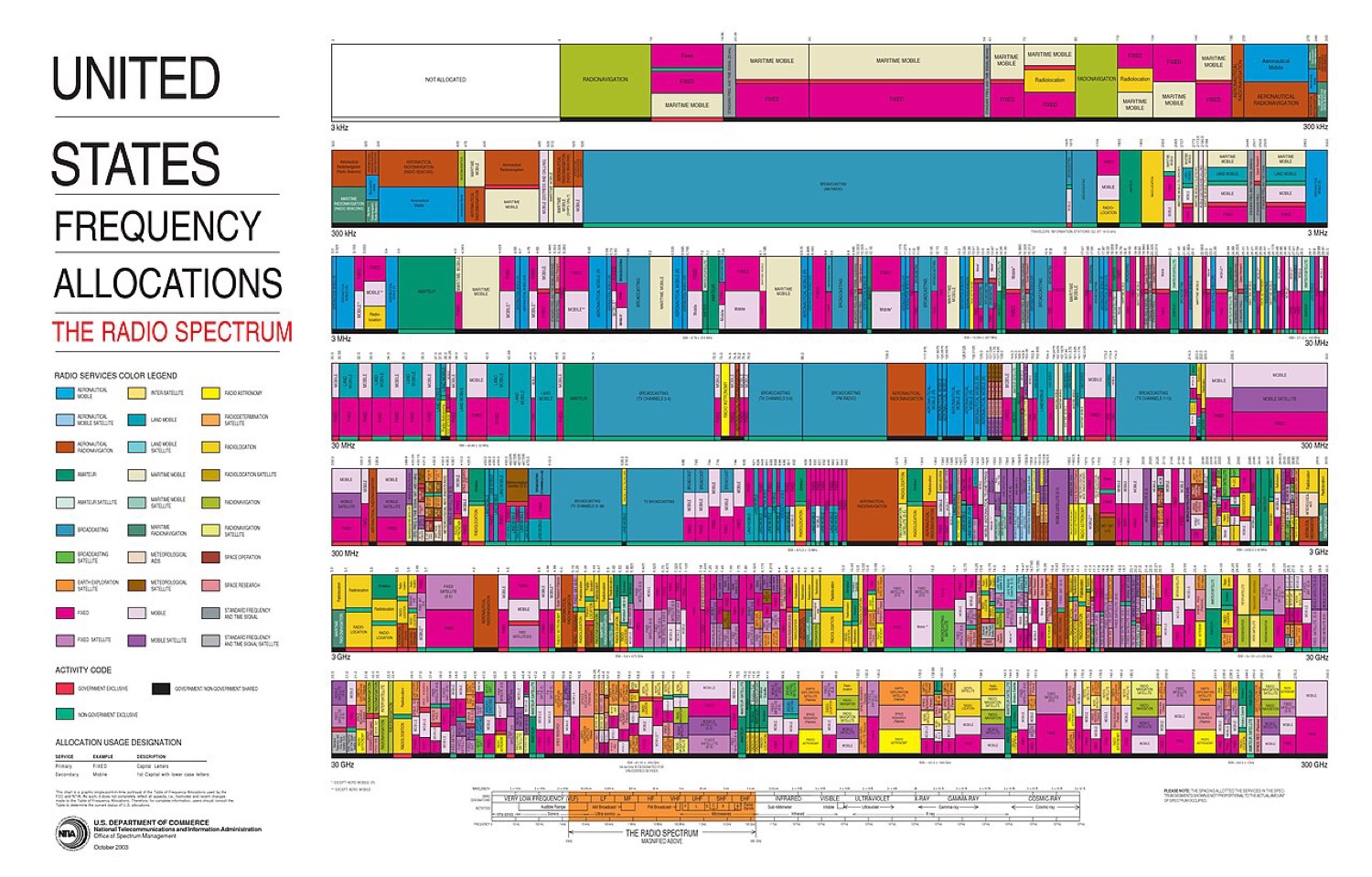
Radio spectrum is a public resource, and the chart above gives some idea of how crowded it is. Since 1994 the US Federal Communications Commission has awarded most commercial licenses by auction, an approach many other countries have adopted. The sums can be enormous. The AWS-3 sale that ended in 2015 drew gross bids of around $45 billion, and the C-band auction that closed in 2021 passed $80 billion.
These auctions are a serious exercise in game theory, designed with help from economists who later won a Nobel Prize for the work. Bidders watch rivals across many simultaneous rounds, try to work out what others are after, and may hide their intentions until late. It is often compared to high-stakes poker, and the comparison is fair: you are betting real money on incomplete information against people trying to read you.
Net neutrality
The question of whether broadband providers may favour some traffic over other traffic has been contested for two decades. In the US, the FCC adopted strong rules in 2015, repealed them in 2017, and restored them in 2024, only to see a federal appeals court strike them down in early 2025. Other regions took a steadier path, and the European Union has had binding rules since 2015. Meanwhile the argument itself has moved, with much of the attention now on large platforms rather than access networks.
Universal service
Most developed countries subsidize connectivity in places where the market will not provide it. In the US, the Universal Service Fund is paid for by a charge on telecom bills, and the Supreme Court upheld its structure in 2025. How to spend such funds, and whether to favour fiber, fixed wireless or satellite, is the live debate.
Trade and security
The 2015 Policy Day looked at how American companies might respond as trade with Cuba began to open up. Today the talk is about restricting trade rather than opening it. Governments have moved to limit certain foreign vendors in sensitive networks, and in the US that has led to a costly program to rip out and replace installed equipment.
An old wire law with a long reach
Communications law sometimes turns up in unexpected places. The Federal Wire Act of 1961 was written to stop bookmakers from using telephone lines to take bets across state lines. Its reach over internet gambling has been reinterpreted by the Justice Department more than once. After a 2018 Supreme Court ruling let each state legalize sports betting, the law became one reason that wagers and their data generally have to stay inside the state where they were placed. As a result, it influences how betting platforms design their networks today. We explain the practical side in our article on geolocation.


