WORKSHOP 1
Understanding RF and Cellular
Radio frequency basics and every generation of cellular, with no prerequisites
Published Aug 3, 2026
For wireless communication of any form, radio frequency is the medium, and anyone working near this industry benefits from knowing how it behaves. The original workshop was a one-day introduction for people with little or no RF background. This is our short version, with no prerequisites.
Frequency and wavelength
A radio wave has a frequency, measured in hertz, and a wavelength, which is the speed of light divided by that frequency. A 700 MHz signal has a wavelength of about 43 centimeters, while a 28 GHz signal has a wavelength of about one centimetre. Nearly everything else follows from that difference. Long waves travel far and bend around obstacles. Short waves carry far more data but are stopped by walls, leaves and even a hand.
Why signals fade
Signal strength falls quickly with distance, a loss that engineers track in decibels, where every 3 dB represents roughly a doubling or halving of power. Obstacles then take their share. Glass with a metal coating can block a surprising amount of signal, which is why modern office towers are often worse for coverage than old brick buildings.
Radio waves also bounce, so a receiver hears several copies of one signal arriving at slightly different times. That effect is called multipath. A casino floor is a classic worst case for an RF planner: rows of metal slot cabinets, mirrored ceilings, and thousands of bodies that absorb signal and move around all evening. Modern systems turn some of this to their advantage. MIMO, which uses multiple antennas at each end, treats those reflections as separate paths and sends different data down each one.
Inside a cell site
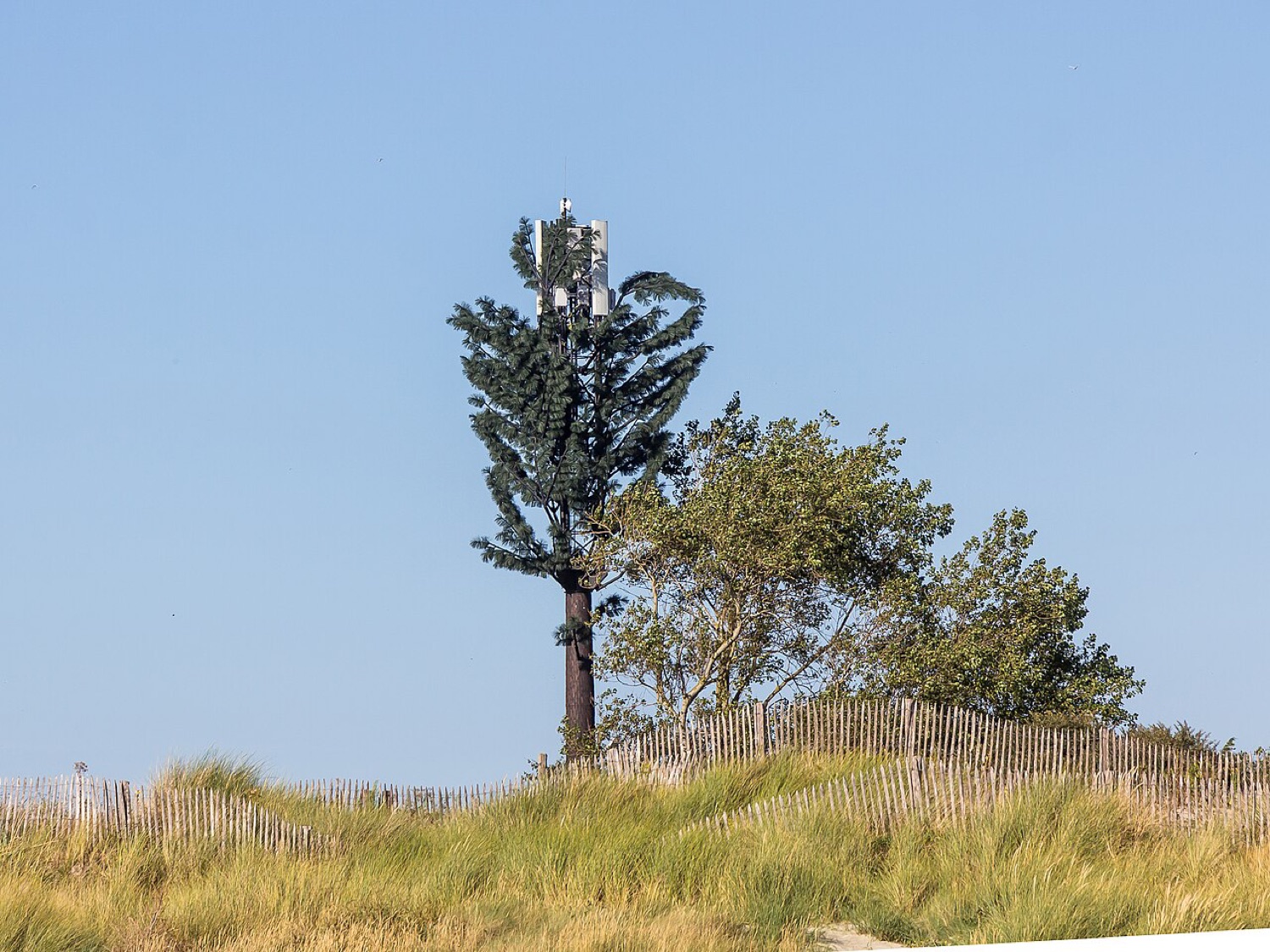
A typical macro site splits its coverage into three sectors, each served by panel antennas that aim the signal slightly downward. Radios increasingly sit on the mast beside the antennas, connected by fiber to baseband equipment at the bottom or further away. A backhaul link then ties the whole site to the operator's core network. Engineers check the result with drive tests, literally driving around with measurement gear to see what a phone would see.
The generations in one paragraph each
1G was analog voice. 2G made voice digital and gave us text messaging.
3G brought usable mobile data, and with it the first real smartphones. 4G LTE rebuilt the network around IP, so that voice became just another kind of data.
5G added much wider channels, massive MIMO and a new core, along with access to both low-band and millimeter-wave spectrum.
Terms worth knowing
- Bandwidth: the width of the channel, which sets the upper limit on data rate.
- Latency: the time a packet takes to make the trip.
- Handover: moving a live connection from one cell to the next.
- Beamforming: steering a signal toward a user by adjusting several antennas together.
Our network glossary covers many more of these terms in a sentence or two each.
More from the Journal


